
ARAM: More Than Just a Fun Game Mode
ARAM is still one of League's most accessible modes, but it is not mindless chaos. Riot's current ARAM systems, from Champion Cards and bench swaps to map rotation and Clash support, reward real adaptation and teamfight skill.
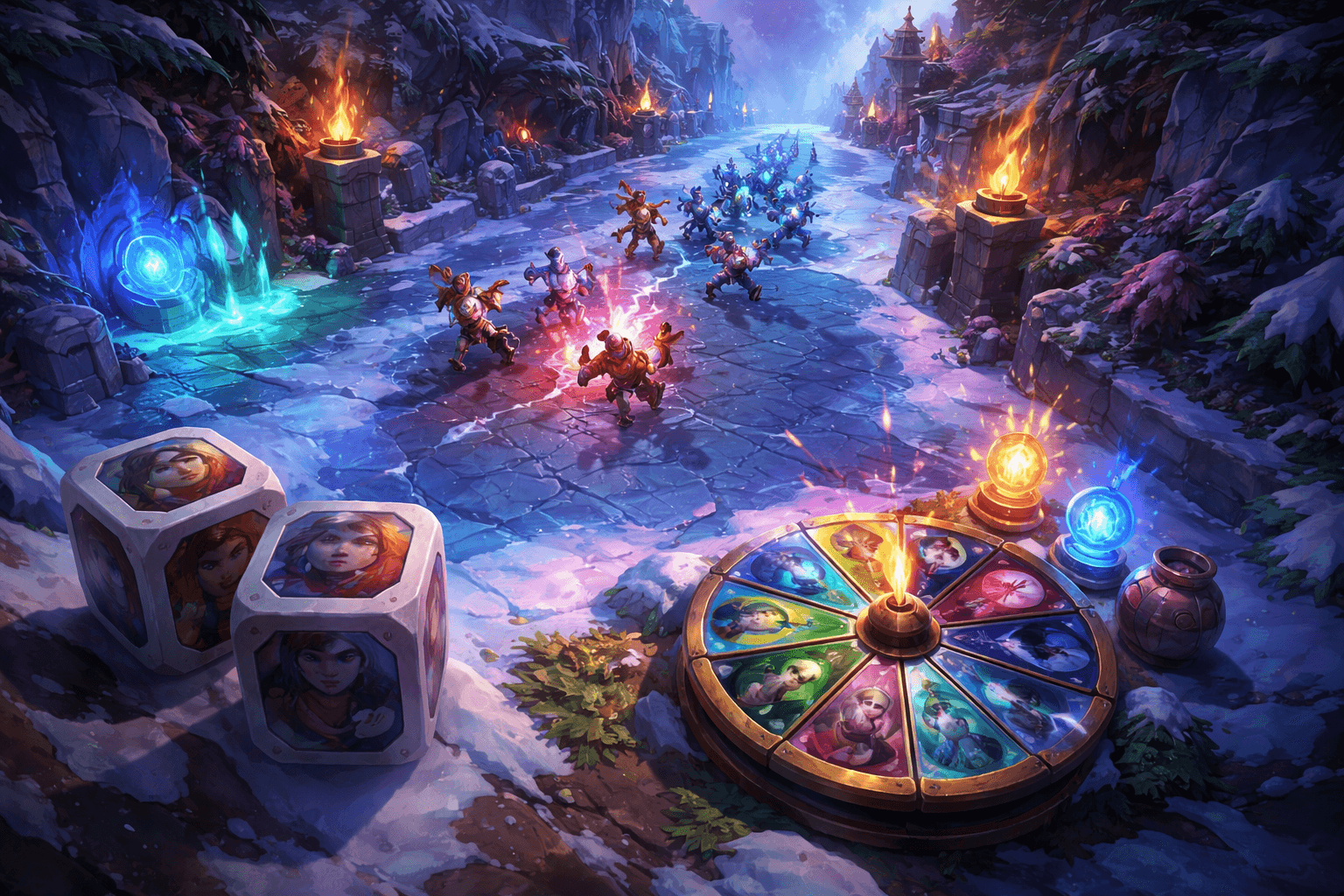
ARAM deserves more respect
Riot describes ARAM as a fast paced, teamfight heavy, one lane mode where champions are assigned at random, and that is exactly why many players underestimate it. On the surface it looks like the pure casual queue. In practice, modern ARAM in League of Legends asks for quick drafting decisions, clean positioning, and constant adaptation.
That matters because ARAM is no longer just a side activity you queue when you are tired of Summoner's Rift. Riot's own support pages treat it as a core matchmade mode that unlocks at level 3, not as a hidden novelty or temporary event.
Modern ARAM is not pure randomness
The biggest reason ARAM feels deeper today is that "random" no longer means "you get one champ and pray." Riot's current system uses Champion Cards, which gives you two options at the start of champ select, with a chance at a third option through the Blessed Card feature. Whatever you do not pick goes to the bench for teammates, and trading is still available.
That system changes the texture of champ select completely. You are still solving a random draft, but now there is room for judgment. Do you keep the comfort pick, take the cleaner frontline option, or leave a strong carry on the bench for someone else? Those are small decisions, but they add up before the game even starts.
Riot also says the champion pool includes your roster plus the last five free to play weekly rotations. Enemy champions remain hidden until loading screen, so every lobby has a layer of uncertainty. That makes adaptation part of the mode's identity, not a side effect.
The map creates real skill checks
The one lane structure strips away a lot of Summoner's Rift complexity, but it also puts fundamentals under a microscope. Riot's ARAM page highlights systems like Hexgates, collapsing turrets, Spirit Blossom portals, power flowers, and cannons on certain maps. Those are not cosmetic details. They change re-entry timing, lane shape, and when teams can force or avoid a fight.
Riot also says that, beginning with Patch 25.13, ARAM maps are randomly selected each match from a rotation that includes Howling Abyss, Butcher's Bridge, and Koeshin's Crossing. That means good ARAM players are not only reading champions. They are also reading the map tools and the pace each version creates.
Because everything happens in one lane, bad spacing gets punished fast. There are fewer places to hide weak positioning, poor target selection, or wasted cooldowns. If you misjudge an engage or walk too far up, the whole lobby sees it immediately. That is one reason ARAM can feel chaotic, but it is also why the mode quietly rewards players with strong teamfight habits.
Why good ARAM players keep outperforming casual ones
A lot of ARAM games are decided by players who understand what their random comp actually wants to do. Some teams need to stall and poke. Others need to stack engage tools and force around narrow timings. ARAM does not give you long laning phases to slowly figure that out. The answer has to come early.
That is where the mode's real skill expression shows up. The faster you identify your win condition, the more valuable every death timer, portal use, bench swap, and first engage becomes. Riot's own framing of ARAM as a teamfight heavy mode supports that reading. The mode compresses decision making into a smaller space, so the quality of those decisions matters more often.
This is also why ARAM can be useful even for players who mainly care about ranked on Summoner's Rift. It gives you concentrated reps on front to back fights, target focus, cooldown tracking, and playing around limited space. It is not a replacement for ranked, but it is absolutely a mode where clean fundamentals stand out.
Riot treats ARAM like a real mode
One of the clearest signs that ARAM is more than a joke queue is that Riot still uses it for organized competition. The current Clash FAQ includes ARAM cups in the 2026 schedule, and Riot specifically notes that ARAM Clash keeps the level 30 and SMS verification requirements but does not require you to have completed ranked placements. That is a meaningful distinction. Riot knows there is a real ARAM audience, and it supports that audience directly.
Riot has also continued investing in ARAM variants rather than letting the mode sit untouched. In February 2026, Riot launched ARAM: Mayhem, a rotating mode that adds Arena style augments while explicitly stating it is not replacing standard ARAM. In the accompanying developer post, Riot explained that adapting augments to a 10 player one lane fight created real clarity and design challenges. That is not how a studio talks about a throwaway mode.
Riot even followed up with ongoing Patch 26.4 changes, including progression and augment tuning for Mayhem. Whether you love the variant or not, the bigger point is simple. Riot is still spending design time on ARAM systems because the mode matters.
So what is ARAM, really?
ARAM is still fun. It is still chaotic. It is still the best place in League to queue up with friends, roll something weird, and fight constantly. But that is only half the story.
The modern version of ARAM has meaningful draft choices, map specific mechanics, sharper punishment for bad positioning, and enough official support from Riot to justify real mastery. If you treat it like nothing more than random nonsense, you miss why some players consistently look comfortable in the mode and others always seem overwhelmed.
Conclusion
ARAM is not just a break from real League. It is real League, compressed into one lane and pushed into a faster, harsher shape. The randomness makes it accessible, but the decisions inside that randomness are what make it interesting.
That is why ARAM is more than just a fun game mode. It is one of the clearest tests in League of Legends of how quickly you can adapt, coordinate, and teamfight when the game stops giving you room to hide.
Sources
EloFactory
Editorial insights from the EloFactory team.
Article details
Related content
Related articles
May 6, 2026
ARAM Mayhem's augment system hides some genuinely absurd champion combos that most players never see coming. Here are the most broken synergies flying under the radar.
May 4, 2026
ELO boosting is when someone artificially raises a player's rank, usually by playing on their account or by manipulating ranked results. In League of Legends, Riot treats boosting as rank manipulation and ties it directly to account sharing and penalties.
Apr 18, 2026
The next League of Legends Blue Essence Emporium is already on Riot's roadmap, but the exact 2026 catalog is not fully public yet. Here is what is confirmed, what usually appears in the shop, and the fastest legitimate way to build a 250,000 BE bankroll.